Analyze the sound. In pilot
Locate sharp sound events and examine their timing. For aligned recordings, compare when an event reaches each microphone, with timing uncertainty shown.
Evidence analysis for legal work
AI analysis for video, sound and documents.
Less searching. More time to build your case.
Less time searching
Every replay, manual search and rebuilt timeline adds to the cost of a case. Locate relevant moments, search completed analysis and save findings with their sources—so your team can spend its time evaluating evidence.
01 · Video analysis
Choose a person sighting to open the footage at that point. Check what is visible, then review the surrounding sequence.
Explore video analysisLooping excerpts · Sound off by default
Public North Avenue footage with reviewed police and firearm annotations. Open a timestamp to examine the original.
Police FirearmLocate sharp sound events and examine their timing. For aligned recordings, compare when an event reaches each microphone, with timing uncertainty shown.
Use person sightings and source timestamps to find the footage you need. Review the original in context.
Save a moment with your note and its source. Reopen it when building a chronology, checking a claim or briefing your team.
North Avenue · BWC 8 · 10:34–10:40 · Boxes reviewed by hand · Sharpened for display
02 · Legal research
Type the facts in plain words. We search nearly 10 million U.S. court opinions, paragraph by paragraph, for courts that faced the same facts. You read the passage and decide how it applies.
Explore legal research“The officer used a Taser on a man who was already handcuffed and was not resisting.”
U.S. Court of Appeals for the Seventh Circuit“Our precedent makes clear that when the officers applied the Taser to Mr. Kingsley in May 2010, use of the Taser violated Mr. Kingsley’s right to be free from excessive force if he was not resisting.”
Was he resisting? In Abbott v. Sangamon County, from the same search, a handcuffed man kept fighting, and the officer was entitled to qualified immunity.
The same search also found
122,691,322 passages searched · Opinion text via CourtListener · Passages to read and weigh, not legal conclusions
3800 W Flournoy · BWC 9 · 04:51–05:01 · Boxes reviewed by hand · Sharpened for display
Spatial intelligence · Research
Explore camera views, sightlines and gaps in the footage through three illustrative scene studies.
North Avenue · BWC 2 · Source interval 02:05–02:15
Authored geometry and estimated movement. Not a measured reconstruction. Audio is editorial narration, separate from source sound.
Sound off. Choose Play to watch the draft.
Open study film ↗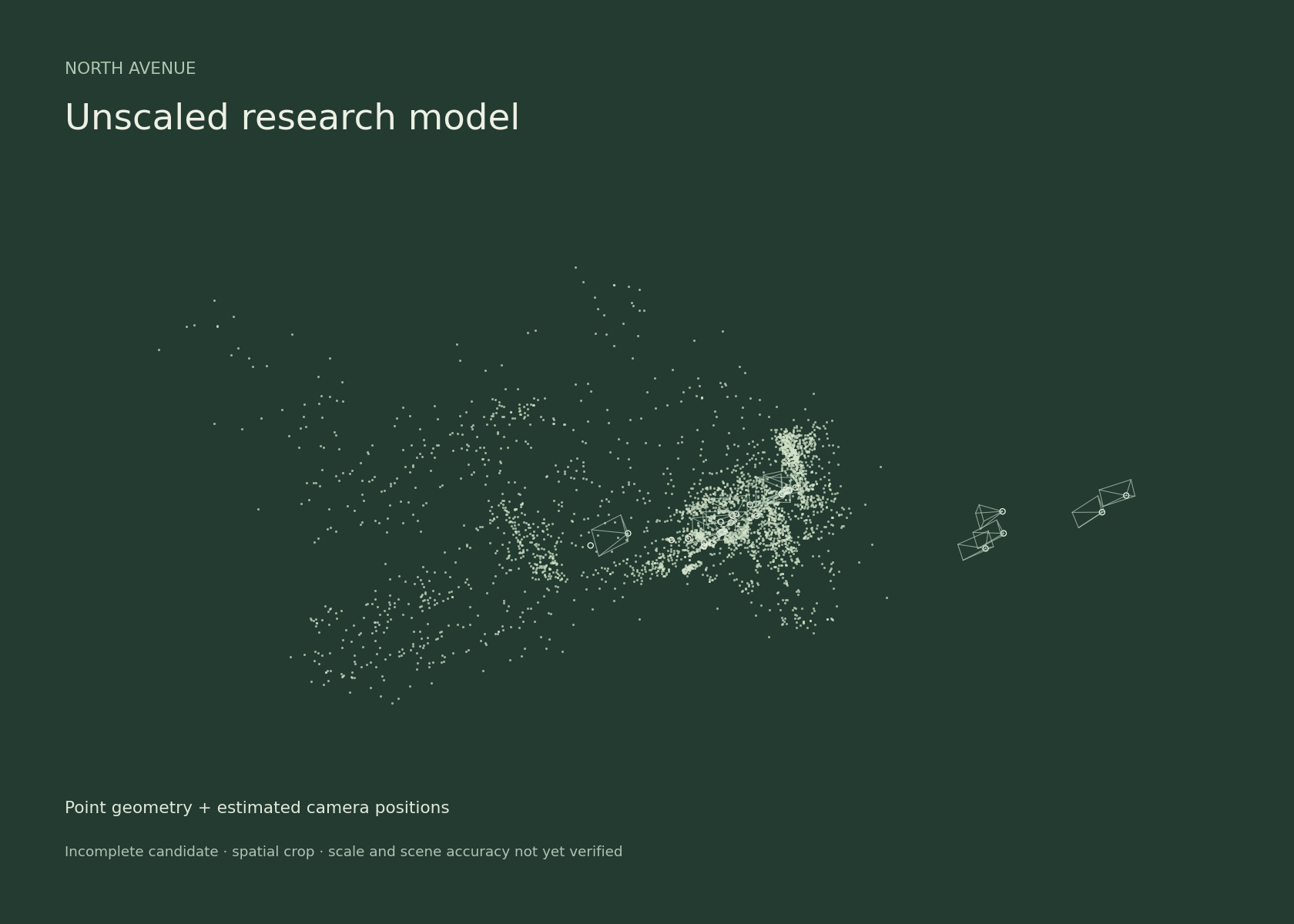
03 · Spatial intelligence
Research in developmentOur spatial research explores how separate camera views fit together, what blocks a view and what the recordings leave unseen.
This is an actual early North Avenue geometry study. It is partial and unscaled; it cannot yet establish distances or reconstruct the incident.
Explore the researchUnder the hood
The parts you don’t see are what make it hold up: answers show where they came from, and gaps are listed, not hidden.
Reports, recordings, dispatch and 911 audio are read against each other. Each difference cites both sources, and agreements are listed too.
That is all a widely used speech filter kept of one public body-camera recording. Audible stretches are decoded again, and anything still unclear is listed for you to hear.
On one public matter, the checks removed 195 statements whose numbers the source did not contain. What remains cites a page or a second.
A description of what is on screen is kept only when a model from another company agrees. Otherwise the moment is marked as not describable.
Each recording carries a checklist of what ran, what ran partly and what did not, so the gaps are visible instead of hidden.
Exports and notes record the fingerprint of the original file. A draft whose original has changed is refused.
Matching the same dispatch transmission across body cameras lined their clocks up to within a few milliseconds in our pilot, showing which camera heard a sound first. It never says what made the sound.
Why Vizion Labs
Vizion Labs is an Illinois not-for-profit working to make advanced evidence analysis accessible to the people and legal teams who need it.
A few useful answers
Vizion Labs helps legal teams analyze recordings and documents, find relevant moments and keep findings linked to their sources. Sound analysis examines events and timing; legal research helps investigate the issues the record raises.
In the hours spent finding relevant footage, repeating searches and locating material already reviewed. Timestamps, searchable analysis and saved findings reduce that repeated work. A pilot can measure the time saved against your current process; the benefit depends on your evidence and review task.
Review a selected recording segment or document pages, or search analysis already completed for a matter. Available results depend on which sources have been processed. Linked recording groups currently require separate review. Sound analysis is scoped to supported recordings during a pilot.
No. A person track follows a visible figure over a bounded interval; it does not establish identity. The blue police labels in this example were reviewed against visible uniforms and markings. Grey Person boxes mark other people the tracker followed; they claim no role. Detection can miss people and tracks can change subjects.
Spatial intelligence is in development. The North Avenue study is partial and unscaled. A measured reconstruction requires sufficient source material, calibration, established scale and validation.
Keep evidence organized within authorized workspaces. Confirm deployment, access and retention requirements as part of your pilot.
Amazon Web Services in the U.S. (N. Virginia), encrypted at rest with AWS KMS, public access blocked, versioning on.
Original files are retained separately from machine-generated results. Review the source identification and retention arrangements for your matter.
Signing in does not grant access to every matter. Workspace membership and matter permissions determine the evidence a user can open.
Sign in securely with your account. Workspace membership determines which matters you can open.
Evidence downloads require authorized matter access. Storage credentials are not supplied to the browser.
The automated evidence pipeline runs in our AWS account in the U.S. Cloudflare serves the website and video streaming. Confirm the hosting and data handling of any additional research services before your pilot.
What we do not claim: security certifications, a separate environment for each firm, or write-once storage. Deployment and retention terms are agreed with you in writing before a pilot.
Tell us what you’re reviewing and which tasks take the most time. We’ll discuss a pilot focused on that work, the outputs you need and how to evaluate the results.
A few details to start. Keep confidential information out of this form.
Please do not submit confidential case details through this form.
This form sends an inquiry. It does not upload evidence.
Checking secure sign-in…